How we think about trends
Knowledge of trends can ensure that you launch the right product at the right time with the right communication and in the right packaging.
Sociology of Trends
a concept, a discipline, and a method
In a complex society where the pace of change is rapid, perspective is a sought-after commodity. Perspective requires immersion, insight, and foresight, an understanding of trend types, their spread, and the sociological process—and this is where trend sociology can be put to good use.
“A trend sociologist is someone who has acquired an understanding of the past, is able to accurately describe and illustrate the present, and can devise probable and commercial scenarios for the future. These scenarios represent an outline of the future, a kind of future universe based on changes in the past and present.”
The concept of trend sociology was introduced by pej gruppen 2001 in connection with the publication of the book of the same name. The discipline of trend sociology deals with knowledge about how to see connections, lines, and movements in a world in constant change, how trends arise, spread, and influence across industries, and what types of people are involved in the process.
To illustrate what the concept entails in more concrete terms, we provide here a definition of the two concepts that together constitute the overall discipline: trend and sociology.
What is a trend?
Trends are dynamic and constantly changing—that is the eternal dynamic of trends. A trend can influence just about everything, from the way we live and work, the way we choose to look, to our values and attitudes. The study of trends is therefore also a study of lifestyle behavior and human actions.
For many, the concept of a trend is somewhat vague and difficult to grasp. However, the term is often used to describe changes in the spirit of the times in society or as an indicator of a more or less permanent shift in values, which is subsequently reflected in trends in lifestyle products and services.
“Trend sociology is the study of people and society and incorporates dimensions from politics, economics, marketing, ethnology, psychology, history, sociology, and anthropology.”
What is sociology?
Sociology is the study of humans as individuals, in groups, or as entire societies through theoretical analysis and practical research. By focusing on the social processes, structures, and patterns that influence humans, sociology represents a different view of modern society, which is often considered to be highly individualistic. For sociologists, individualistic society can only be understood through the study, analysis, and investigation of the social context in which humans live. Sociology thus makes it possible to describe and understand processes, structures, and patterns in collective societies and groups consisting of individuals.
What does trend sociology involve as a discipline?
Trend sociology is a broad, generalist discipline that deals with the past and present in order to say something about the near future. In this context, it draws on several different, more or less related, subject areas within, among other things, politics, economics, history, psychology, and marketing. This diversity of disciplines provides a versatility and depth that is both beneficial and appropriate when working with change and trend development.
Trend sociology can be said to be both a specialized and a generalist discipline. Specialized because it deals specifically with trends and development mechanisms, but also generalist because the working methods used require a solid professional foundation.
Trend sociology – both more and less than a science
Is trend sociology a science or not? The study of trends is an interdisciplinary science and, at the same time, a form of meta-science, i.e., a science that stands above all other sciences, using them as "basic sciences."
Trend sociology uses existing sciences and, based on these, establishes a new holistic approach to the analysis and interpretation of society. It is therefore more of an approach than a real science.
Trend research does not focus on fulfilling the criteria or definition of science in its traditional form. Instead, it focuses on constantly being at the forefront of change and perceiving, understanding, and interpreting the new in a more holistic way.
Six trend types
What do they contain?
In categorizing trends that are significant for lifestyle products, communication, and design, a distinction is made between the following six types.
- Types of societies
- Paradigms
- Gigatrends
- Megatrends
- Fashion/style trends
- Mayflies
The first two types provide the necessary overall context and perspective for working with trends. The three subsequent types of change can be used as aids for a more practical approach to product development, communication, and timing. It is in these types of change that the "stories" are found and developed to form the basis for tactical or strategic initiatives. The last type of change is less manageable, a curiosity, but not entirely without significance. In addition, it is worth mentioning that every trend is fundamentally part of a larger change. For example, trends in fashion are part of a larger economic, political, cultural, and/or sociological change. In other words, trends at a general level can be viewed as relatively homogeneous changes within the framework of an even larger change.
Trend research – how to work with it
The recipe for becoming a trend analyst is relatively simple, but still quite difficult to apply in practice and translate into something tangible. Using the right tools is a time-consuming process, and to get the most out of your research, you need to develop some fixed routines. There is no set "recipe" for how to best work with the tools—only routine and experience can bring that kind of clarity.
The 10 most important tools
Reading
The world is full of data and information, and at first glance it may seem impossible to stay up to date. But by choosing sources that are both generalist and niche-oriented, it is possible. The work of finding books, magazines, trade journals, and other materials that provide both an overview and sufficient professional immersion in a niche area is very important. Once the most important sources have been found, a pattern emerges in the research that needs to be done. As in sports, interval training is important. Here, one could talk about interval reading. A particular medium comes with a rhythm that makes it possible to reflect and discuss between publications.
Listening and watching
You can listen to both speech and music. Music is in many ways a mirror of society. You can listen to mainstream music, follow the charts, and study what the avant-garde produces and listens to. Radio is actually an overlooked medium in the modern media landscape. Radio is often a fantastic channel for immersion. A scan of just Scandinavian radio stations' programming offers plenty of opportunities for immersion in society-related topics. National and international TV stations, as well as local TV stations, provide a good picture of one of the most important contradictions in modern life – local/global.
Surfing the web
The internet is fantastic, but it is a time sink. The web is full of detailed information of all kinds. Just don't think that all wisdom can be found online. In fact, the information you can find is often sectarian and/or very superficial. Rarely does it provide perspective. It would be an impossible task to refer to specific sites and closed databases, as the internet is constantly changing. However, good search engines provide reasonably easy access to many good sources. Furthermore, before using closed databases, you should be absolutely sure of the purpose of your search – not all types of information can be contained in a database.
To travel
Traveling offers two opportunities. First, the journey itself. Here you can study lifestyle behaviors up close on many levels. From the businessman with his rolling suitcase, smartphone, and suit, to the more folksy behavior of the charter tourist. Second, you can study the destination. The world's major urban centers are still important to visit regularly.
Noting differences
When you travel, diversity is one of the things that strikes you. Diversity in both behavior and attitudes is important to study because diversity and variety often open your eyes to new things that can be transferred from country to country or tribe to tribe. In fact, the seeds of many new products, sales, and marketing are hidden here. So sit down on a bench for 15 minutes and look at your surroundings, notice the deviations and differences, and make a note of them.
To ask
It is important to be able to ask the right questions. Whether it is to a search engine on the internet or to your fellow passenger on a flight to Tenerife. If you ask the right questions, you often open up a flood of thoughts, ideas, comments, and opinions. This is something you can use if you are curious and interested in other people.
Discussing and sharing knowledge
Discussion opens up new avenues, insights, and opportunities for discovering unusual angles and details. You can engage in spontaneous discussions with people you meet, but you can also stage professional discussions among other trend analysts or with focus groups.
To systematize
Once you have gathered all your impressions and knowledge, it is important to systematise everything. Systematisation is a continuous process. It could be done every quarter, every month or every Friday. The important thing is the stop-up effect, where it is possible to create a partial overview and take new steps towards further research. Some people cut articles out of newspapers and magazines and stack them by subject area. They count how much and what is written about a topic. This is the more quantitative way of doing it. The other is more qualitative, where one or more people have the job of creating a thematic or perspective overview—a kind of map of the topics.
To sort
Throwing things away or continuing to focus often requires more than just mathematical sense. Experience is probably the best skill in this situation. But you have to be careful not to throw away the wrong things, because in modern society you also have to think about so-called wild cards. But sorting is important, because not everything can be equally important.
To put into perspective
The most important thing is perspective. It is perspective that creates the opportunity for others to benefit from what you have been working on. Trend research is about taking a helicopter view and seeking an overview. Perspective is the tool. Perspective requires historical knowledge – or knowledge of where to find it. By focusing on the other nine tools, you will actually become better at putting things into perspective over time.
Share knowledge
A final – and essential – element in the toolkit of a trend analyst is knowledge sharing. Without knowledge sharing, the overview and insight will not be translated into anything. And don't think that sending a cc email of your conclusions to your colleagues is enough. It is precisely in discussions that new, important observations often arise that can elevate the collected knowledge to a higher and more useful level.
Want to stay up to date on trends? Take a closer look at the Pej Group's magazine TID & tendenser, which keeps you up to date on trends across all lifestyle industries.
Trend researchers – who are they?
Trend researchers work to decode, analyze, and translate trends into concrete advice and guidance.
What can a trend researcher help you with?
- Offer alternative thinking and methods.
- Provide a unique perspective on the near future.
- Connect the dots and see the connections.
- Provide specific suggestions for change.
- Identify competitive advantages.
- Ensure a high degree of success.
The ultimate goal is to ensure the launch of a viable product or service, ensure that marketing and communication contain the right messages through the right channels, that the right sales channels have been chosen – and that the strategy is upheld.
“The future belongs to a very different kind of person with a very different kind of mind – creators and empathizers, pattern recognizers and meaning makers.”
— Daniel Pink, motivation expert and author
How does a trend researcher work? And what exactly is a trend, if they had to put it into words? Why and how does one become a trend researcher? Is it the result of carefully planned education and career planning, or is it pure coincidence? Some have a goal in mind, while for others it happens completely by itself (or via a large number of detours).
We interviewed 17 different trend researchers about their understanding of and work with trends.
- Alf Refn
- Anne Skare Nielsen
- Cathrine Gro Frederiksen
- Daniel Burrus
- David Bosshart
- David Mattin
- David Shah
- Elina Hiltunen
- Henrik Vejlgaard
- James Bidwell
- Kirsten Van Dam
- Louise Byg Kongsholm
- Mads Arlien-Søborg
- Magnus Lindkvist
- Maria Mackinney-Valentin
- Sara Ingemann Holm-Nielsen
- Ståle Økland
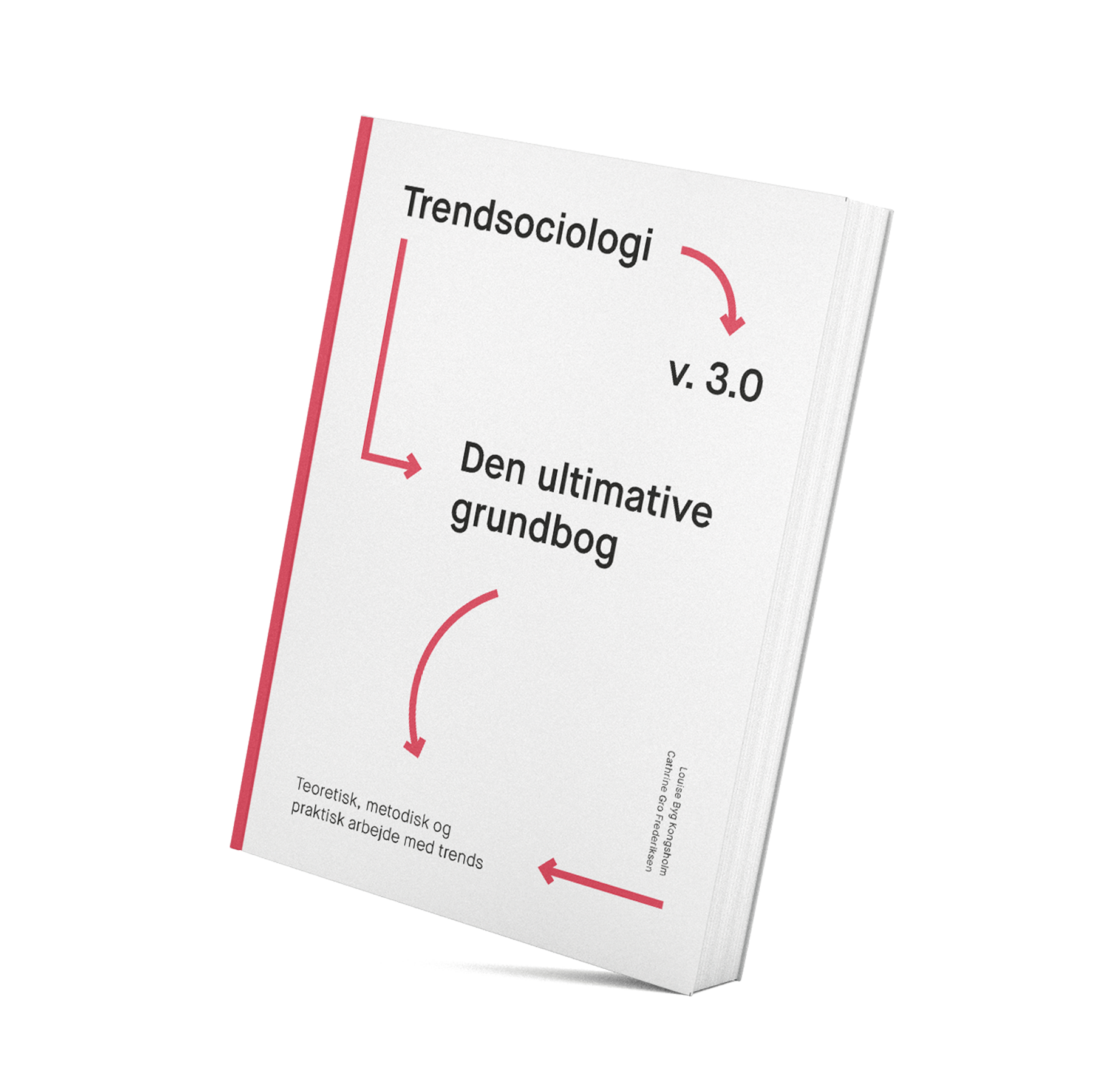
Trendsociologi v. 3.0
The ultimate primer. Theoretical, methodological, and practical work with trends – in both Danish and English.
What is the purpose of the book?
The aim is to demystify the concept of trend sociology and provide a concrete and thorough introduction to the concept of trends itself, removing some of the ambiguity and dispelling the myths. The reader should be able to understand the big picture of changes in society, as well as zoom in on specific types of trends and their content, significance, and impact within different industries. In addition, the purpose of the book is to provide the reader with a number of concrete instructions for processes, methods, and tools.
What does the book contain?
This book shares knowledge and experience about how to see connections, lines, and movements in a changing world, society, and culture. The content is a constructive mix of history, theory, method, and practice, which has emerged from almost 45 years of work with practical trend and development projects, lifestyle research, and communication. The book's methods and toolbox enable the reader to see through the big and small changes. These are concrete mindsets, concepts, methods, and approaches that can form the basis for practical work with change and trends.
Want to learn how to spot trends yourself?
In collaboration with Aarhus Business Academy, pej gruppen developed a training program where you can learn to work with trends in practice. Read more about the diploma program.